When the Old Way and the New Way Go Head-to-Head in a Family Business
There's a conversation that happens in family businesses all over this country, in every industry you can name. It might happen at a kitchen table or in a conference room or in the parking lot after a tense meeting. But it goes something like this:
"We need to change how we're doing this."
"We've always done it this way."
"I know. That's the problem."
If you've been part of a family business for more than five minutes, you've either had this conversation or you're about to. The tension between honoring what built the business and evolving to keep it alive is the central drama of every multigenerational operation — and it doesn't get easier just because the people involved love each other. Sometimes it gets harder.
This isn't a piece about who's right. It's a piece about how families navigate the disagreement without blowing up what took decades to build.
Why the Conflict Is Actually a Sign of Health
Let's start with something that might be counterintuitive: the tension between tradition and growth is a feature, not a bug.
A family business where everyone automatically defers to the oldest generation isn't a legacy — it's a time capsule. It might preserve the original values and methods perfectly, but it's also probably not growing, adapting, or bringing in the next generation in any meaningful way.
On the other hand, a family business where the younger generation steamrolls the older one isn't building on a legacy — it's just a regular business that happens to have family members in it. The heritage, the hard-won wisdom, the brand identity built over decades — all of that gets lost.
The conflict, when it's handled well, is what keeps both of those failure modes in check. You need someone in the room who says, "Wait — why are we doing it the new way again?" just as much as you need someone who says, "We can't keep doing it the old way forever."
Case Study: The Bakery That Almost Modernized Itself Out of Existence
A family bakery in the Midwest — third generation, founded by a Czech immigrant in the 1940s — ran into exactly this problem when the second-generation owner's son came back from business school with a plan to scale.
The plan made sense on paper. Centralize production, move to a commercial kitchen, expand distribution, reduce labor costs by cutting the most time-intensive handmade elements. The projections showed a 40% revenue increase within three years.
What the projections didn't show was what happened when they ran a test batch. Customers noticed immediately. Not dramatically, not with complaints — they just quietly started buying less. When the family dug into the feedback, they kept hearing variations of the same thing: it doesn't taste the same.
The handmade elements that had seemed like inefficiencies were actually the product. They weren't just slower — they produced a genuinely different result. The older generation had known this, had tried to say so, but hadn't been able to articulate it in business school language.
The bakery eventually found a middle path: they modernized their ordering system, their marketing, and their supply chain, but kept the core production methods intact. Revenue grew — not 40%, but sustainably and without sacrificing what made them worth growing in the first place.
The lesson here isn't "tradition always wins." It's that the older generation's resistance to change sometimes contains real information that's worth slowing down to understand before you override it.
Case Study: The HVAC Company That Had to Let Go
Not every story tips toward tradition, though. Consider a family HVAC business in the South, now in its second generation, where the founder's insistence on doing every service call personally — or at least reviewing every ticket — had created a bottleneck that was actively costing the company customers.
The founder's instinct was understandable. His reputation was built on personal accountability. Every job that went out under his name was a job he'd personally stood behind. The idea of expanding the team and trusting other technicians to maintain that standard felt genuinely risky to him.
But the business was turning away work. Good technicians were leaving because there was no room to grow. And the founder, now in his late 60s, was exhausted.
The resolution came when his daughter — who'd grown up in the business and understood exactly what her father was protecting — designed a quality control system that formalized the standards he'd always applied intuitively. Written checklists, photo documentation, customer follow-up protocols. She essentially translated his instincts into a replicable process.
"I didn't change what he built," she said. "I just wrote it down so other people could do it too."
The founder had to let go of being the bottleneck. But the values he was protecting — quality, accountability, personal service — those survived the transition. Because his daughter understood that those weren't just his preferences. They were the reason customers came back.
The Questions That Actually Help
When a family business hits one of these disagreements, there are a few questions that tend to cut through the noise faster than most.
Is this about the outcome or the method? A lot of tradition-versus-change conflicts are actually both sides agreeing on the outcome but disagreeing on how to get there. Separating those two things often reveals more common ground than anyone expected.
What specifically would be lost if we change this? Not "it won't feel the same" — but concretely, what customer experience, what quality element, what brand promise would actually be at risk? If you can name it specifically, you can often find a way to protect it even while changing the method.
What's the cost of not changing? This question is for the traditionalists in the room. Keeping something the old way has a cost too — in efficiency, in the ability to attract and retain younger staff, in long-term competitiveness. That cost deserves an honest look.
Who has actually tried the new approach? A lot of resistance to change in family businesses is resistance to the idea of change, not to a tested result. Running a real pilot — small scale, time-limited, with clear success metrics — can move a conversation from philosophical to practical very quickly.
The Honest Truth About Who Wins
In healthy multigenerational businesses, nobody wins the tradition-versus-growth argument outright. What actually happens is messier and more interesting than that.
The businesses that survive and thrive tend to be the ones where both sides stay genuinely curious about what the other is protecting. Where the older generation trusts that the younger generation's drive to change comes from caring about the business, not dismissing its history. And where the younger generation trusts that the older generation's resistance to change comes from real knowledge, not just stubbornness.
At Pcs, En & Grandson, we've lived some version of this tension ourselves. And what we've found is that the argument — the real, honest, sometimes uncomfortable argument — is where the best decisions get made. Not in spite of the disagreement, but because of it.
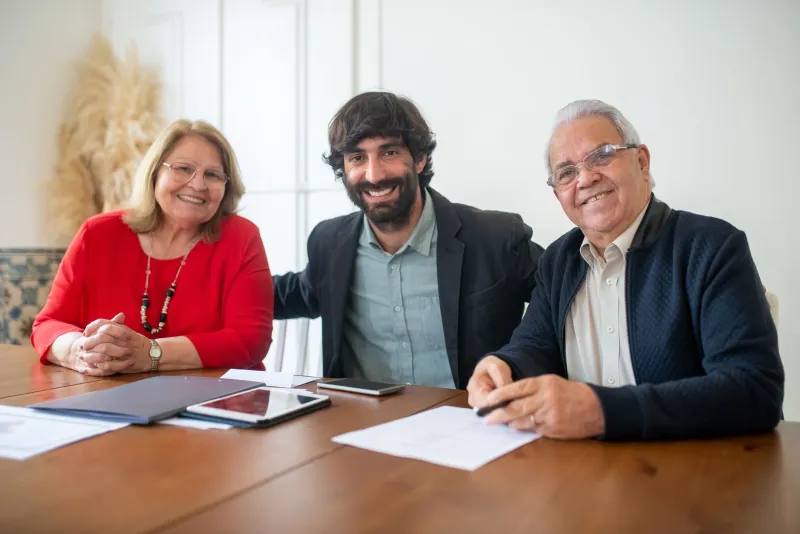
Three generations in a room, each one bringing something the others don't have. That's not a recipe for conflict. That's a recipe for something that lasts.