Slow Down, Kid: What Three Generations of Waiting Taught Us That No Productivity App Ever Could
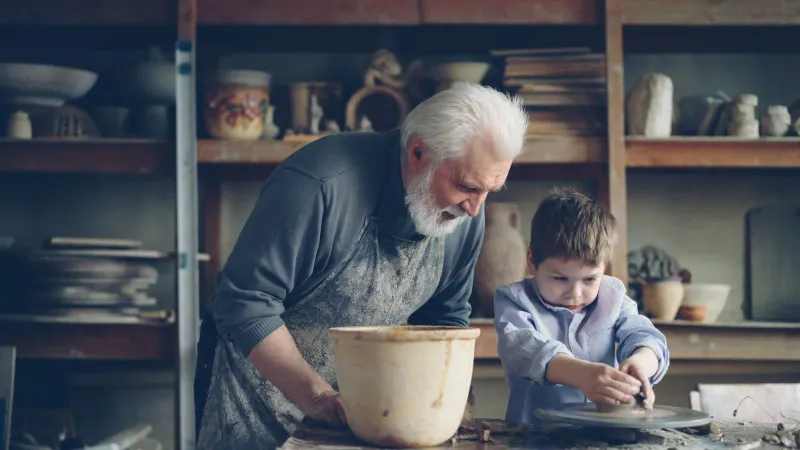
There's a moment in most family businesses — and honestly, most multigenerational households — where the youngest person in the room thinks they've got it figured out. They've watched a YouTube tutorial. They've read the Reddit thread. They've maybe even taken a course. And then the oldest person in the room just... looks at them. Not unkindly. Just with this particular kind of patience that says, we'll see.
That look is worth more than any TED Talk.
The Speed Trap Nobody's Talking About
We live in a culture that has collectively decided patience is a bug, not a feature. Productivity culture tells us to batch our tasks, automate our habits, and compress our learning curves. There's a whole industry built around convincing us that mastery is a weekend away — just buy the right program, follow the right system, and skip the boring parts.
But here's the thing nobody selling you a course wants to admit: the boring parts are the point.
Research on expertise — particularly the work built on Anders Ericsson's deliberate practice framework — consistently shows that deep skill acquisition requires sustained, focused repetition over long periods. Not glamorous. Not monetizable as a three-day bootcamp. Just time, attention, and the willingness to be bad at something for longer than feels comfortable.
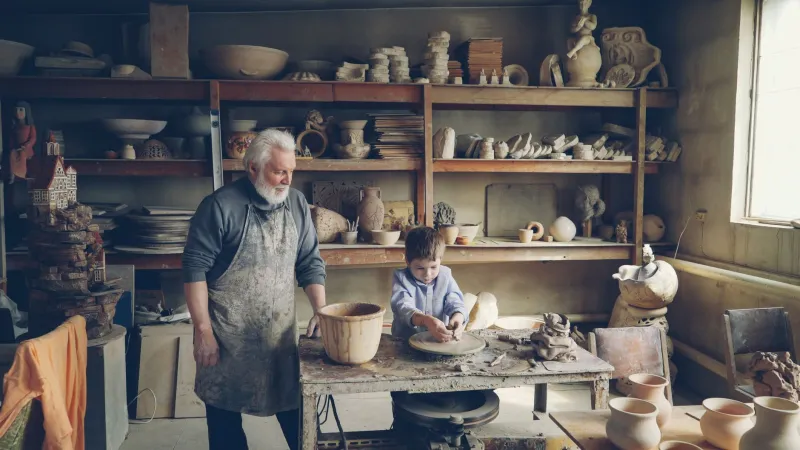
Who's been teaching exactly that for centuries? Grandparents. Family shop owners. The aunt who wouldn't let you near the sewing machine until you'd threaded a needle a hundred times by hand.
What Multigenerational Living Actually Teaches
Grow up around older generations — really around them, not just at Thanksgiving — and you absorb something almost impossible to teach in a classroom. You learn that most things worth doing take longer than you think. You learn that cutting corners has a way of showing up later, usually at the worst possible time. You learn that expertise looks effortless from the outside precisely because it was earned through years of effort nobody else saw.
In a family business context, this plays out constantly. The senior generation isn't just passing down technical knowledge — they're modeling an entire relationship with time and difficulty. When a grandfather spends forty-five minutes on a single joint in a cabinet because it has to be right, that's not inefficiency. That's a lesson in standards. When a grandmother reconciles her books by hand even though there's software for it, she's not being stubborn — she's staying connected to every dollar in a way that builds real financial intuition.
These are the kinds of lessons that don't transfer through documentation. They transfer through proximity.
The Mentorship Research Actually Backs This Up
Studies on workplace mentorship consistently find that the most effective mentoring relationships are long-term and informal — not structured programs with quarterly check-ins, but organic relationships where the junior person observes, assists, fails, and tries again under the guidance of someone who's been through it. The National Mentoring Partnership and similar organizations have noted that meaningful mentorship often takes one to three years before its real benefits crystallize.
Family businesses are running that experiment constantly, across generations, without even calling it mentorship. They just call it working together.
And the outcomes are measurable. Family-owned businesses make up an estimated 64% of U.S. GDP and employ about 62% of the workforce, according to data from the Conway Center for Family Business. They also tend to have longer planning horizons than publicly traded companies — they're not optimizing for the next quarter, they're thinking about what they're handing down to the next generation. That longer view is itself a product of patience.
The Competitive Advantage You Can't Buy
Here's the argument we'd make at Pcs, En & Grandson — and we're a little biased, sure — but hear us out: the slow-mastery approach that gets passed down through families is genuinely a competitive advantage in today's market.
When everyone else is rushing to launch, iterating fast, and pivoting constantly, the business or craftsperson who has internalized deep patience stands out. They build things that last. They make decisions with a longer time horizon. They're less likely to panic when results don't come immediately, because they've been taught — by someone who lived it — that results rarely come immediately.
The frustrating irony is that this kind of patience is extremely difficult to develop outside of those intergenerational relationships. You can read about it. You can understand it intellectually. But until you've sat next to someone who genuinely embodies it — who isn't rattled, who keeps showing up, who trusts the process because they've seen it work across decades — it's hard to really internalize.
How to Preserve It Before It's Gone
The risk, of course, is that we let this transfer stop. When family businesses dissolve, when generations stop living near each other, when the pressure to modernize pushes out the older way of doing things — the patience goes with it.
So what can families and small businesses actually do?
First, create deliberate slow-down moments. Not every process needs to be optimized. Some things should be done the long way on purpose, so the younger generation understands why speed isn't always the goal.
Second, let elders teach at their own pace. Resist the urge to summarize, shortcut, or turn grandpa's lesson into a bulleted list. The meandering story is often the lesson.
Third, document the why behind the slow approach. When you record family processes, don't just capture the steps — capture the reasoning. Why does it take this long? What goes wrong when you rush it? That context is what makes the knowledge transferable.
Patience, it turns out, isn't a personality quirk. It's a practice. And the families who've been practicing it for generations are sitting on something genuinely rare — and genuinely valuable. The question is whether we recognize it before we accidentally optimize it out of existence.